
Caroline's Secret
That Caroline Calloway essay and GLP-1 spam texts and loving your weird imperfect body

When the word “anorexia” was first tossed at me from the other side of a doctor’s office, I scoffed.
I didn’t think it was possible to have an eating disorder at 28 years old. Anorexia was for teenagers and characters in movies, not grown adults who had lost a few pounds. I didn't “have an eating disorder,” I was simply weird with food, as I had been for as long as I could remember. I just cared about being healthy. How was that wrong?
Here’s the thing: In January of 2020, I was in what I would’ve called the best physical shape of my life.
…I was also passing out at work and hiding it from my husband, depriving my body of food while strategically choosing workouts based off of how many calories I could burn, and doing things like sneaking into the breakroom after telling coworkers “I brought my own lunch, but thanks,” grabbing a slice of community pizza, taking a bite from the very center, then instantly spitting it into a napkin and throwing it away before anyone could see. So, I was right about one thing: I was certainly weird with food.
It wasn’t until my issues became scary and un-ignorable that I took them seriously—and even then, I needed convincing.
But this is not a story about my eating disorder, or my recovery journey1. This is about The World That We Live In (circa 2026).
In hindsight, after my diagnosis, I was able to see the telltale footprints of an eating disorder in the sand behind me—ebbing and flowing at various stages of life, with no clear starting point or origin story.
Maybe it was because of the dramatic weight swings and body changes in my teens due to the onset of kidney disease and the various medications I took while trying to find my ideal cocktail. Maybe it was an attempt at convincing myself I have control. Maybe it was an exercise in self-punishment. Maybe it was society, the “heroin chic” movement, the covers of People Magazine and The National Enquirer, the excessive use of the words “flabby” and “saggy” in the late 90s.
Or maybe it’s simply the fact that it is really weird to have a body—a body that is the result of thousands of years of evolution and also subject to trends that come in and out of fashion at ever-increasing speeds.
It’s kind of pointless to analyze, because the answer probably lives somewhere in between all of the above and then some. The sad reality is that there are so many reasons to have an eating disorder. That’s part of why they’re so insidious, so rampant, and so hard to kick.
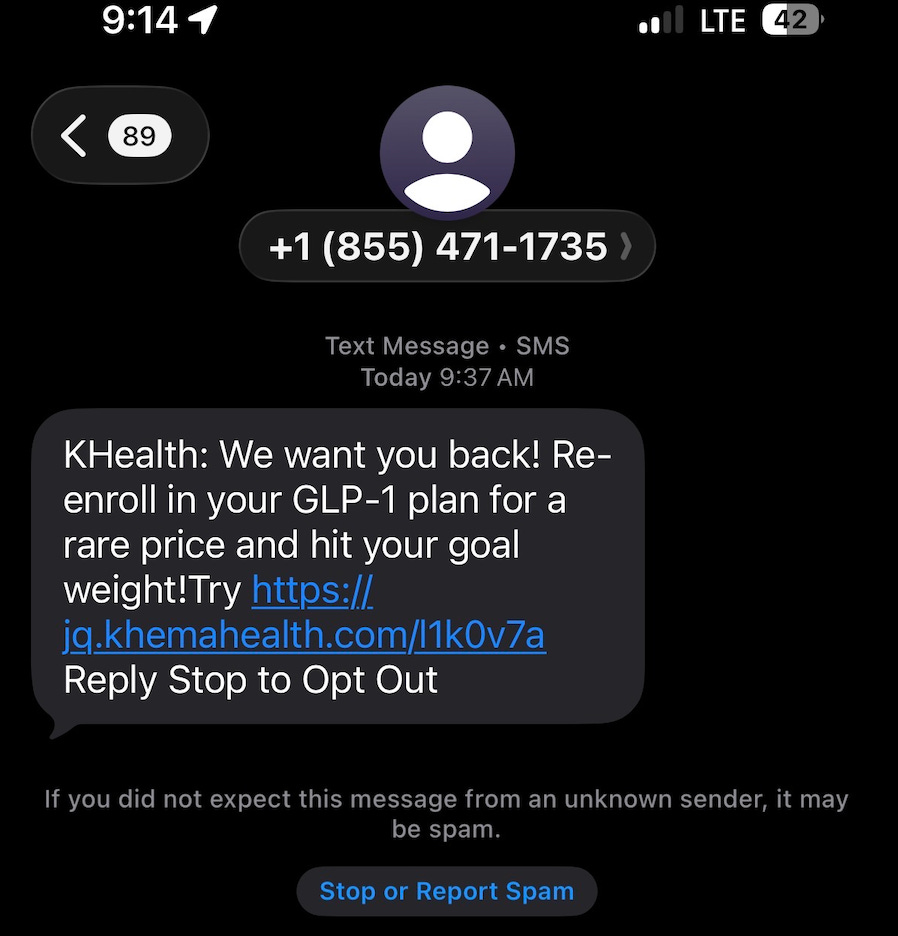
So when I get texts selling me promises from GLP-1s, or read stories like Caroline Calloway’s recent essay in Byline, I have a whoooooole lot of mixed feelings.
Caroline Callo-weigh (I had to)
If you haven’t read Caroline’s essay, the TLDR is this: Caroline went to a doctor with ankle weights hidden under her pants in order to qualify for an Ozempic prescription (she actually referred to it as a subscription, in a move that is either an interesting choice or a very telling Freudian slip). She lost 15 pounds and claims to feel more confident than ever.
Actually, in her words: “I’m 115 now and my life is in every way better.”
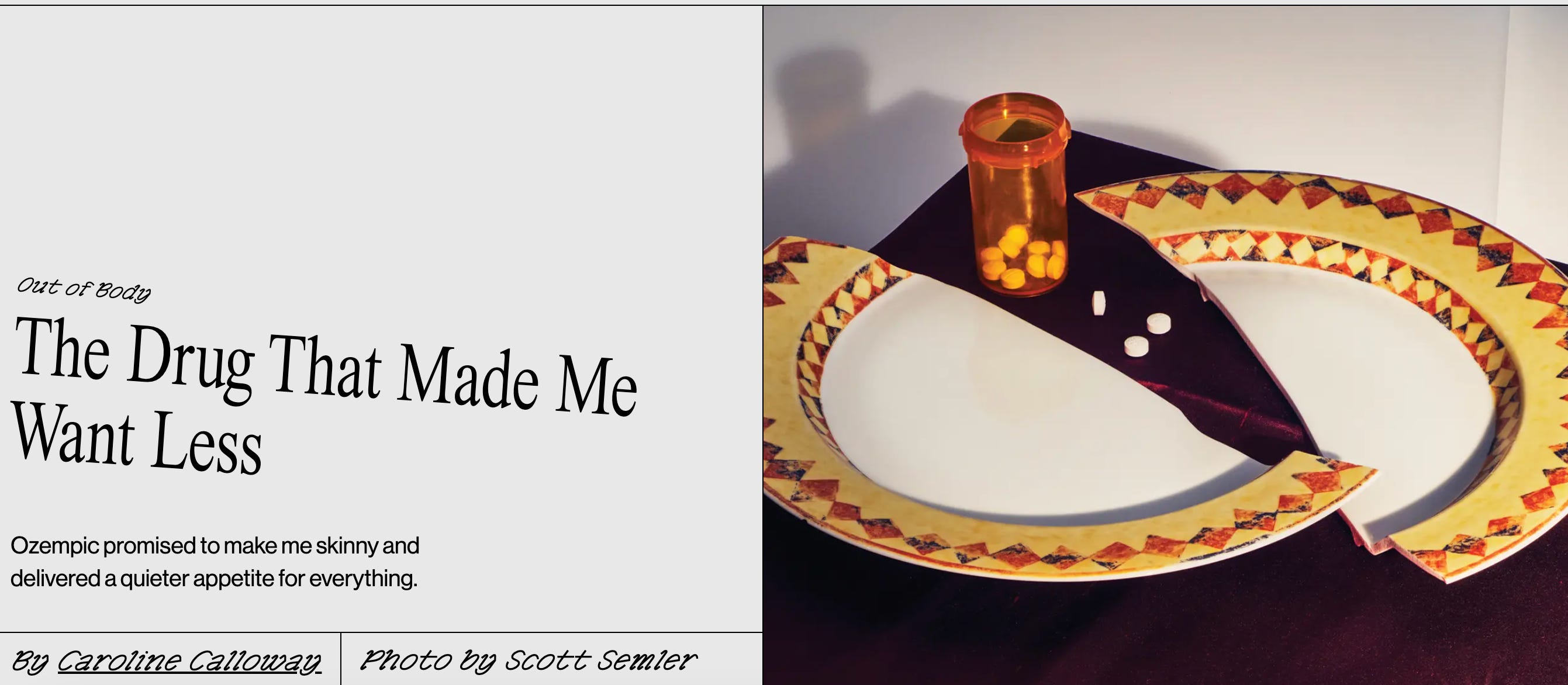
Now, given Caroline’s past2, it would be easy to discredit everything she does as rage-bait, engagement-bait, attention-bait, or whatever kind of bait you prefer. She seems to be an equal-opportunity baiter3 with a flair for the dramatic4. But whether she truly believes what she’s saying is neither here nor there5, to me. She wrote it. She published it.
Many who have either had an eating disorder or been fascinated by them at one point will likely be familiar with “pro ana” culture. It is an extremely dark movement that lives in very accessible places, and its hallmarks are competition (often disguised as encouragement) and attempts at making something sinister seem profound.
I’m ashamed to admit I’m deeply familiar with the latter—the belief that being tortured was a good thing, that suffering was important, that it said something about me and my depth that I was willing to do it. Underneath all of my shame and embarrassment, there was part of me that wore my eating disorder like a badge of honor—not necessarily externally, but within myself. It felt like important, necessary atonement for an inherent flaw.
Much of Caroline’s essay reminded me of a dressed up version of pro-ana conversations I’ve witnessed in eating disorder circles on Twitter and Reddit. It reminded me of conversations I’ve had with myself—the justifying, the world-building, the attempts at wrapping a lie in layer-upon-layer of logic.
It felt like she was trying to sell me6 something.
But who knows? Maybe in her skinniness, Caroline has genuinely found something I never could: Fulfillment. Peace. An end to the racing thoughts and the self-hatred and the picking apart and the incessant need to go further and further and further.
I had to recover from an eating disorder to find even a shred of these things—but maybe all I needed to do was get even smaller!
The “subscription prescription” era of capitalism
Okay, so: the elephant in the room. The once-weekly needle in the haystack.
Let me just say: I am far from anti-GLP-1! If you’re on a GLP-1 and thinking this is the part where I start to browbeat you, you’re wrong! GLP-1s are life-saving medicines for some, and life-changing for others. I would never shame anyone for taking one. I genuinely don’t even shame Caroline Calloway for taking one7.
GLP-1s have a variety of benefits that we can and should celebrate!
…AND they are capable of being abused.
…AND they are capable of massively distorting our already-absolutely-wacky beauty standards.
…AND I would personally rather not receive seven hundred spam texts or see a bazillion ads offering me “fat-burning” and “belly-shrinking” benefits.
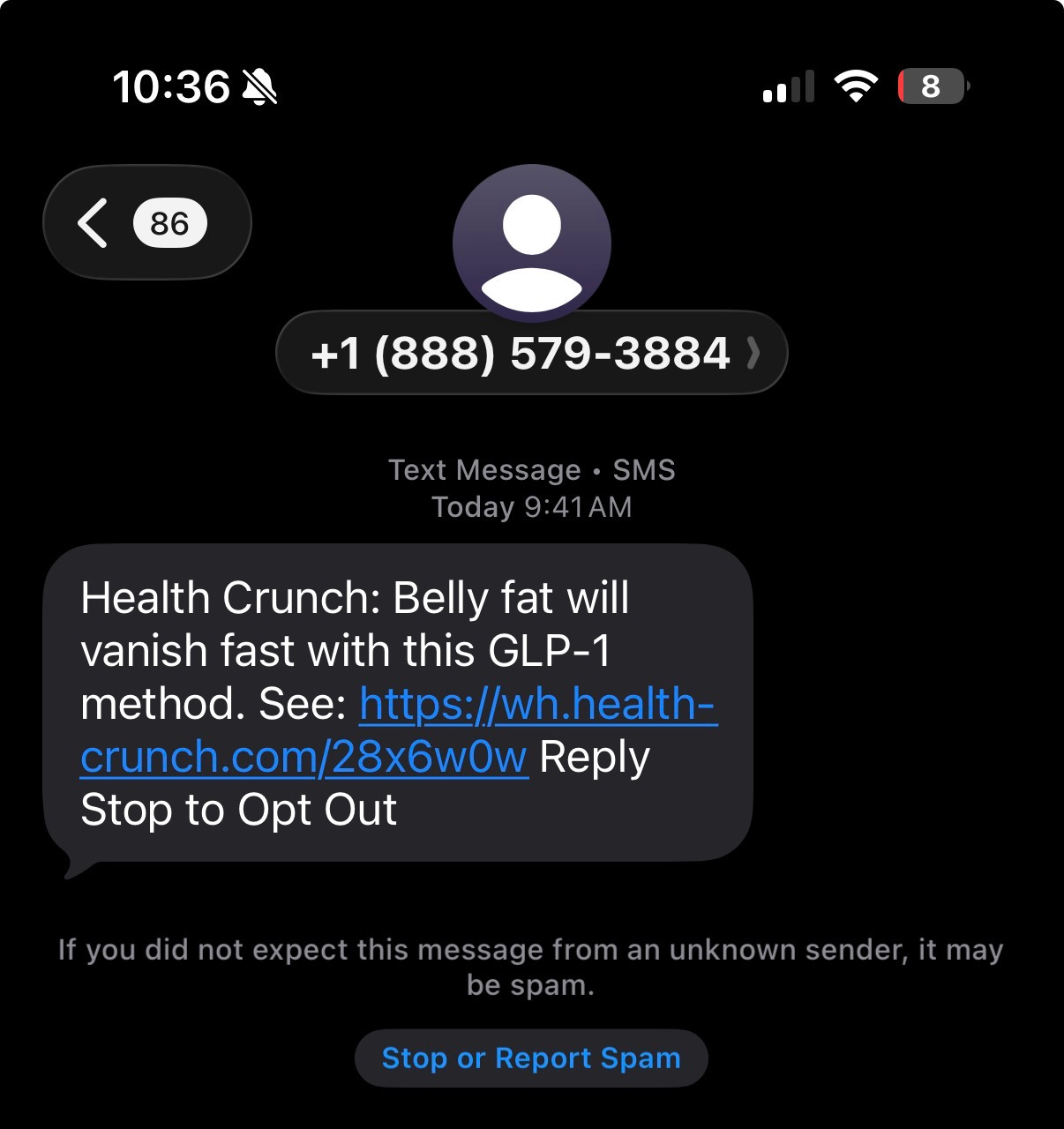
Because this is where the whole trendification of bodies thing comes into play again—and where our collective body dysmorphia starts to take over.
It would be impossible to ignore that everyone is getting smaller. The people we see on screens are shrinking, soft edges sharpening.
We’re not very good at seeing ourselves. We probably never have been! And as the mirror becomes increasingly distorted—as we continue to invent new ways to hate our bodies, and then invent new “miracle cures” that claim they’re capable of taking all of that hatred away—it will only get harder.
I can’t speak for anyone else, but I can say that, for me, at the end of the day, my eating disorder was never really just about being skinner, or smaller. I feel gross saying this, but I was already skinny. There was no weight I could’ve hit, no size I could’ve worn, no shape I could’ve found myself in that would’ve felt like a final destination or an endpoint.
And I have to believe that our collective views on bodies—and how they “should” look—go further and deeper than size, too.
I’ll give an example that is different but maybe a little bit related: I naturally have very hairy arms. Like, unbelievably hairy. Take whatever amount of hair you’re picturing and multiply it by at least eight. I shave my arms now, and have for a very long time—because having hairier arms than my father was something I personally just was not strong enough for! Since shaving my arms, it’s true that I feel slightly more physically confident when I walk into a room, knowing that the hairiness is not visible. But the hairiness still lives within me. I still have hairy arms, whether the rest of the world knows it or not. The insecurity that the hairiness caused, the discomfort of having a physical body that isn’t perfect, continues to plague me. The anger I had toward my arms for being hairy in the first place didn’t disappear the moment I started shaving them. The embarrassment I felt about existing didn’t go away with the swipe of a razor.
In fact, a new embarrassment appeared—one I still contend with as I continue to draw new lines about what I am and am not willing to modify about my body—shame that I’m not capable of loving it in its most natural state.
Long story short: I’m still learning how to be okay with myself, how to coexist with my body!!!!!!
So if you need to take a GLP-1, please, for the love of God, take it! If you simply want to take a GLP-1, consult your doctor (ideally not while wearing ankle weights that distort the reality of your situation) and, if they approve, by all means, take it! If you feel like it will make you feel even slightly more confident when you walk into a room, and you are comfortable with the risks and the unknowns associated with the medication, I will never, ever judge you.
But if you’re looking for a silver bullet that will make you love yourself, or make the rest of the world love you, I don’t know if any needle or drug can give you that.
OBVIOUS NOTE: There is so much nuance to this whole conversation that I cannot even begin to represent here—I know my perspective is just one of millions. I’m so so so curious to hear how other people feel about this! If you’re taking a GLP-1 for aesthetic or quote-unquote “non-essential” reasons, I’d really love to hear your experience. If you read Caroline’s essay and thought “Finally, someone is saying it,” I’d love to hear from you. I am writing this not because I think I know The Answers but because I want to engage in more conversations about this topic and try to find them together.
Quick plug for Maddie’s Secret
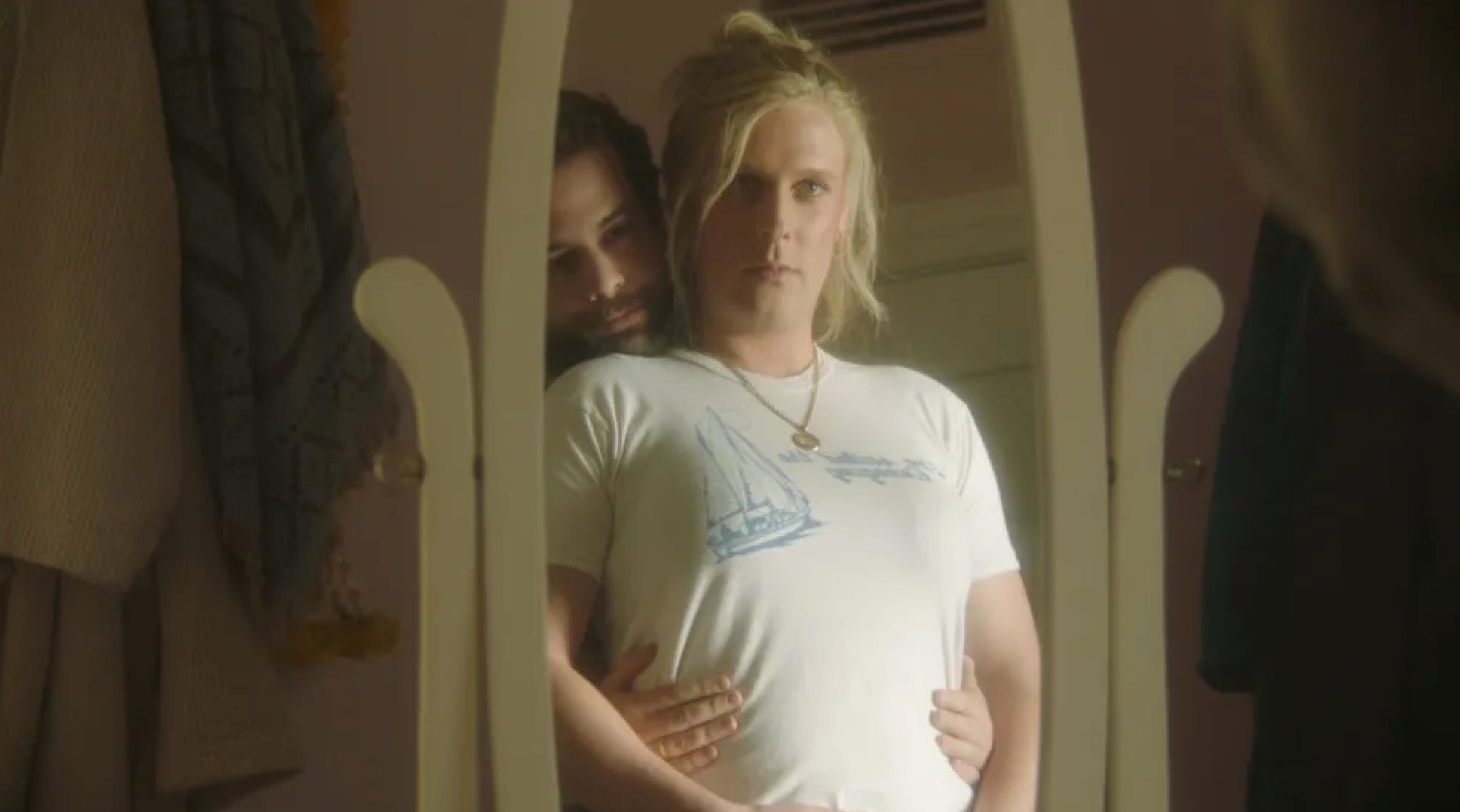
If you’re interested in watching a hilarious movie with a lot of heart that talks about the perils of having a body and does a surprisingly lovely job of talking about eating disorders, Maddie’s Secret was SUCH a pleasant surprise. I knew I was going to see a movie that would make me laugh—I did not expect to see something that would make me cry! I honestly don’t want to say more than that because I think it’s best if you go in a bit blind.
Highly recommend, if it’s playing in a theater near you.
TLDR: I’m in recovery, which is a lifelong journey! Yay!
this is just kind of barely scratching the surface, LOL — if you’ve got a few hours to kill, do a deep-dive
and, like, good for her, I guess? Idk. People like CC confuse me, because there is a real person underneath all of that bait—and I imagine it must be frustrating to be reduced to peoples’ worst possible take every time you open your mouth. But also maybe that’s what she wants? But also maybe she should be more considerate about what she says when she opens her mouth? But also maybe not?
Like, is the whole “contraband ankle weights” thing hyperbole, or are we supposed to actually believe that? Especially given the fact that it’s all too easy to get a “subscription” for a GLP-1 via a Telehealth appointment these days?
I mean, I want to know, but I don’t think even she actually does.
and maybe herself?
I maybe shame her for her methods of procuring the aforementioned GLP-1. But honestly my bigger issue with what she wrote is just her bold claim that being 15 pounds skinnier dramatically improved her life, and the implication/call-to-action that this would be true across the board for others, also.
Thank you for writing and sharing this!
Such an important piece! I religiously shaved my arms for years, and it was fine until I started obsessing over the stubble that would inevitably show up two days later. It’s helped to surround myself with people who talk openly about their struggles, and I’m so happy to call you a friend. ♥️